Convert your measurements here:
Showing posts with label axial atom. Show all posts

December 8, 2011

Compounds With Octahedral Shape

For compounds whose central atoms possess six bonding electron pairs, their bonded atoms are oriented towards the corners of an octahedron.

The best examples are the PF6- ( phosphorus hexafluoride or hexafluorophosphate) ion and the SF6 ( sulfur hexafluoride ) molecule whose Lewis structures are shown below.
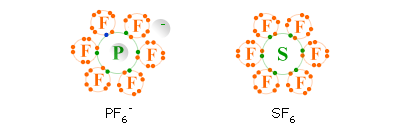


The ground state electronic configuration of the two central atoms:
P1s2 2s2 2p6 3s2 3px1 3py1 3pz1
S1s2 2s2 2p6 3s2 3px2 3py1 3pz1


In the excited state of the two central atoms above, their valence electrons are assumed to be distributed this way:
1s2 2s2 2p6 3s1 3px1 3py1 3pz1 3dz21 3dx2 - y21


Since six equal orbitals are required, it is assumed that sp3d2 hybridization is used to form six hybrid orbitals:

1s2 2s2 2p6 (sp3d2)1 (sp3d2)1 (sp3d2)1 (sp3d2)1 (sp3d2)1 (sp3d2)1
Phosphorus acquires an extra electron for its sixth orbital.


Geometry of PF6-


  • shape of ion: octahedral
  • bond angle of axial atoms: 180°
  • bond angle of equatorial atoms: 90°
  • bond angle between an equatorial atom and an axial atom: 90°


Axial atoms are in white circles; equatorial atoms are in black circles.


An octahedron is superimposed on the PF6- ion.


Geometry of SF6


  • shape of molecule: octahedral
  • bond angle of axial atoms: 180°
  • bond angle of equatorial atoms: 90°
  • bond angle between an equatorial atom and an axial atom: 90°

November 28, 2011

Molecules With Trigonal Bipyramidal Shape

Molecules like PCl5 (phosphorus pentachloride) and PBr2Cl3 (phosphorus dibromo-trichloride) possess five covalent bonds whose electron pairs are arranged in a trigonal bipyramidal geometry.

The central atom of these molecules, phosphorus, has only three unpaired electrons out of its five valence electrons as can be seen from its electronic configuration below:

1s2 2s2 2p6 3s2 3px1 3py1 3pz1ground state configuration


But the Lewis structures of the given molecules, as shown below, indicate that the phosphorus atom uses five unshared electrons to form five covalent bonds.


It is, therefore, assumed that phosphorus uses the empty d orbital to "promote" 1 electron from 3s orbital to d orbital,

1s2 2s2 2p6 3s1 3px1 3py1 3pz1 3dz21excited configuration


and, through hybridization, form five sp3d hybrid orbitals which are then used to bond with chlorine and bromine atoms.

1s2 2s2 2p6 (sp3d)1 (sp3d)1 (sp3d)1 (sp3d)1 (sp3d)1excited configuration


Geometry of PCl5


  • shape of molecule: trigonal bipyramidal
  • bond angle of axial atoms: 180°
  • bond angle of equatorial atoms: 120°
  • bond angle between an equatorial atom and an axial atom: 90°


Axial atoms are in white circles; equatorial atoms are in black circles.


A trigonal bipyramid is superimposed on the PCl5 molecule.


Geometry of PBr2Cl3

Due to the different axial and equatorial positions the two bromine atoms can assume, PBr2Cl3 (phosphorus dibromo-trichloride) has three geometric isomers as shown below.


Except for the first isomer in which the bromine atoms are in axial positions, the other two geometric isomers of PBr2Cl3 are polar.