Convert your measurements here:
Showing posts with label tetrahedral geometry. Show all posts

January 11, 2013

Compounds With Bent Shape

The following chemical species have bent geometry:

water molecule, H2O
nitrogen dioxide molecule, NO2
nitrite ion, NO2-
sulfur dioxide molecule, SO2

The illustrations and discussion below show how the presence of non-bonding electron pair(s) on a molecule's central atom affects the geometry of the molecule and the bond angle of its atoms.


Geometry of Water, H2O

As shown in its Lewis structure below, the central atom of water has four pairs of electrons: two bonding pairs and two non-bonding or lone pairs.


These pairs of electrons are presumed to take a tetrahedral arrangement in space.


Here, the water molecule is depicted as being superimposed in a tetrahedral outline.


The lone pairs of electrons are relatively closer to the nucleus of the central atom and they tend to crowd the two bonding pairs together so that the H-O-H bond angle is less than the ideal tetrahedral angle of 109.5°.


  • shape of water: bent or angular
  • H-O-H bond angle: 104.5°


Geometry of Nitrogen Dioxide, NO2

The central atom of nitrogen dioxide, nitrogen, has two sigma bond electron pairs and an unpaired non-bonding electron as shown in its Lewis electron dot structure below.


In order for this group of electrons to be farthest from each other, it is predicted that they take a trigonal planar arrangement.


Shown in the next illustration is the nitrogen dioxide molecule superimposed on a trigonal planar outline.


The observed O-N-O bond angle of 134.1° in nitrogen dioxide molecule, being closer to trigonal angle of 120°, confirms this prediction.

The opening out of the O-N-O bond angle is due to the less crowding affected by the half filled non-bonding orbital of the central atom.

This half-filled orbital accounts for the nitrogen dioxide (NO2) being paramagnetic.


  • shape of nitrogen dioxide: bent or angular
  • O-N-O bond angle: 134.1°


Geometry of Nitrite Ion, NO2-

An addition of an electron to the central atom of nitrogen dioxide (NO2) creates the nitrite anion, NO2-.


In the above diagram, the resonance structures of nitrite ion is shown. The oxygen atoms in red partial shades are atoms with negative formal charge.

As is the case with the nitrogen dioxide, the arrangement of the two sigma bond electron pairs and the lone electron pair of nitrite ion's central atom lies on a trigonal plane.


The only difference is the observed O-N-O bond angle of 115° for the nitrite ion. This bond angle now being much closer but less than the trigonal angle of 120° is attributed to the filling up of the non-bonding orbital of the nitrite ion's central atom.

The lone electron pair is relatively closer to the central atom and occupies more space than the adjacent bonding electron pairs do.


  • shape of nitrite ion: bent or angular
  • O-N-O bond angle: 115°


Geometry of Sulfur Dioxide, SO2

Referring to the contributing Lewis structures of sulfur dioxide below, there is a -1 formal charge on one of the oxygen atoms and +1 formal charge on the sulfur atom which cancel each other out, leaving the molecule with zero net charge.


Given the two sigma bond electron pairs and one lone electron pair on the central atom of sulfur dioxide, as shown in the figure above, SO2 is predicted to have a trigonal planar geometry.


A trigonal planar outline is shown below superimposed on the sulfur dioxide molecule.


Given this geometry, it is expected that SO2 molecule has an angular shape. This is supported by the fact that sulfur dioxide has a dipole moment.

The O-S-O bond angle is expected to be somewhat less than the trigonal angle of 120° due to the presence of a lone electron pair on the central atom.


  • shape of sulfur dioxide: bent or angular
  • O-S-O bond angle: less than 120°

November 14, 2011

Molecular Geometry: Compounds With Tetrahedral Shapes

A compound with four electron pairs at its central atom has a tetrahedral shape.

If one of the four electron pairs is unshared or non-bonding, then the compound becomes pyramidal in shape.

Although triangular pyramid is also a tetrahedron, there is a distinction between compounds with tetrahedral and pyramidal shapes: the location of their central atoms.

A compound with triangular pyramidal or simply pyramidal shape has its central atom located at the apex of the pyramid whereas a compound with tetrahedral shape has its central atom located at the center of tetrahedron.

Here are the lists of compounds included in this post:

compounds with tetrahedral shapes
CH4
F3SN
CCl4
ClO4-
NH4+
BF4-
SO4=


compounds with pyramidal shapes
NH3
SO3=
ClO3-
NF3
XeO3
F2SeO

Along with the illustration of a compound's shape, its Lewis structure is also included together with a brief discussion regarding the effect of lone electron pairs or double/triple bonds on the bond angles and/or the use of hybrid orbitals by certain atoms for covalent bonding.

The first three compounds discussed in details below serve to represent the rest of the compounds.


Methane, CH4


  • shape of molecule: tetrahedral
  • H-C-H bond angle: 109.5°


The Lewis structure and one of the four equal H-C-H bond angles of CH4.


A tetrahedron superimposed on a CH4 molecule. The four hydrogen atoms are oriented towards the corners of the tetrahedron.


Ammonia, NH3


The ammonia molecule has a non-bonding electron pair at the top of the tetrahedron as depicted below.


The Lewis structure of NH3 shows it has a lone pair of electrons which occupies more space than any of the bonding electron pairs resulting to H-N-H bond angles being less than the ideal tetrahedral angle of 109.5°.

Since molecular shapes involve atoms only, the shape of ammonia will be minus the lone pair of electrons. It is a triangular pyramid with the nitrogen atom at the apex.


  • shape of molecule: triangular pyramidal
  • H-N-H bond angle: 106.6°


A triangular pyramid superimposed on the ammonia molecule.


Trifluorothionitrile, F3S≡N


  • shape of molecule: tetrahedral
  • F-S-F bond angle: less than 109.5°
  • N-S-F bond angle: greater than 109.5°


Referring to the Lewis structure above, sulfur atom exceeds the octet configuration or the eight valence electrons required for bonding by utilizing empty d orbitals and creating hybrid orbitals (for a discussion of constructing Lewis structure of compounds, see Drawing Lewis Electron Dot Structure or Formula).

F3SN has a tetrahedral shape which means it has four electron pairs directed towards the four corners of a tetrahedron but its Lewis structure shows 6 bonding electron pairs (see my previous post for a discussion of compounds' different coordination geometries and the corresponding number of electron pairs of their central atoms).

In determining the shapes of compounds, only electron pairs involved in sigma bonds are considered.

As for the bond angles, greater repulsion exerted by electron pairs from double and triple bonds cause the bond angles containing them to be greater than those bond angles containing single bonds only.


Compounds With Tetrahedral Shape


The Geometry of CCl4


The Lewis structures of CCl4 and ClO4-.


The chlorine atom in ClO4- or perchlorate ion acquires one electron to complete its eight valence electrons and utilizes empty d orbitals to bond with four oxygen atoms by sharing all of its eight valence electrons.

Referring to the illustration above, atoms in partial grey and red shades are atoms with formal charges. To learn more about the calculation of formal charges, read Drawing Lewis Electron Dot Structure or Formula.

The Geometry of ClO4-


The Geometry of NH4+


The Lewis structures of NH4+ and BF4-.


The NH4+ or ammonium ion is formed by NH3 acting as a Bronsted base and accepting a proton.

On the other hand, BF4- or boron tetrafluoride ion is formed by BF3 acting as a Lewis acid and bonding with a fluoride ion acting as a Lewis base.

For a discussion of Bronsted acid-base reactions, see Solving Weak Acid/Base Dissociation Problems.


The Geometry of BF4-


The Geometry of SO4=


The Lewis structures of SO4=


Given the geometry of SO4= or sulfate ion as shown above, there are two possible Lewis structures for it. The second Lewis structure is considered to be the correct one because it is more stable and consistent with the experimental data.

The sulfur atom in the second Lewis structure exceeds the octet configuration or the 8 valence electrons required for bonding by acquiring two extra electrons and utilizing empty d orbitals.


Compounds With Pyramidal Shape


The Geometry of SO3=


The Lewis structures of SO3= and ClO3-


The sulfur and chlorine atoms in the above Lewis structures acquire extra electrons to fill up its valence electron shells and are assumed to use hybrid orbitals involving empty d orbitals to form covalent bonds with oxygen atoms.

The Geometry of ClO3-


The Geometry of NF3


The Lewis structures of NF3 and XeO3


The Geometry of XeO3


The Geometry of F2SeO


The Lewis structure of F2SeO

November 2, 2011

Geometries of Molecules and Ions

The shapes of compounds, either molecules or polyatomic ions, are very important in helping us understand better their reactions.

Fortunately, the geometries of most molecules and ions can be predicted quite reliably even by considering only their electron-electron pair interactions.

The idea is that the repulsive forces that exist between bonding and non-bonding pairs of electrons of a molecule or an ion cause those pairs of electrons to adapt certain spatial arrangement that allows minimum repulsion.

The spatial arrangement of the electron pairs of a molecule depends on its number of atoms and the number of valence electrons of its central atom.

So, in order to predict the geometry of a molecule or an ion, one needs to know its number of bonding and non-bonding pairs of electrons by determining the following:

  • total number of atoms in the molecule or ion
  • number of valence electrons of the molecule's central atom
  • the Lewis structure of the molecule or ion


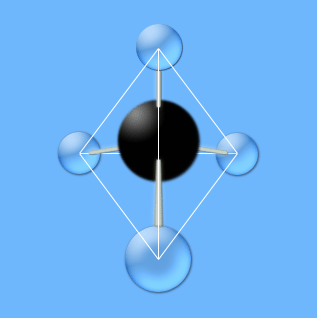
In the following illustrations, all of the possible coordination geometries for different compounds are depicted using ball-and-stick models.

In each illustration, information such as number of electron pairs of the compound and the number of its atoms are given.


Linear Geometry


  • number of electron pairs: 2
  • coordination geometry: linear
  • number of atoms: 3 ( 1 central atom, 2 bonding atoms)


Trigonal Planar Geometry


  • number of electron pairs: 3
  • coordination geometry: trigonal planar
  • number of atoms: 4 ( 1 central atom, 3 bonding atoms)


Tetrahedral Geometry


  • number of electron pairs: 4
  • coordination geometry: tetrahedral
  • number of atoms: 4-5 ( 1 central atom, 3-4 bonding atoms)


Trigonal Bipyramidal Geometry


  • number of electron pairs: 5
  • coordination geometry: trigonal bipyramidal
  • number of atoms: 6 ( 1 central atom, 5 bonding atoms)


Octahedral Geometry


  • number of electron pairs: 6
  • coordination geometry: octahedral
  • number of atoms: 7 ( 1 central atom, 6 bonding atoms)


Pentagonal Bipyramidal Geometry


  • number of electron pairs: 7
  • coordination geometry: pentagonal bipyramidal
  • number of atoms: 8 ( 1 central atom, 7 bonding atoms)