Convert your measurements here:
Showing posts with label octahedral geometry. Show all posts

December 8, 2011

Compounds With Octahedral Shape

For compounds whose central atoms possess six bonding electron pairs, their bonded atoms are oriented towards the corners of an octahedron.

The best examples are the PF6- ( phosphorus hexafluoride or hexafluorophosphate) ion and the SF6 ( sulfur hexafluoride ) molecule whose Lewis structures are shown below.
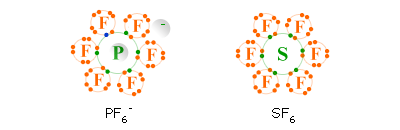


The ground state electronic configuration of the two central atoms:
P1s2 2s2 2p6 3s2 3px1 3py1 3pz1
S1s2 2s2 2p6 3s2 3px2 3py1 3pz1


In the excited state of the two central atoms above, their valence electrons are assumed to be distributed this way:
1s2 2s2 2p6 3s1 3px1 3py1 3pz1 3dz21 3dx2 - y21


Since six equal orbitals are required, it is assumed that sp3d2 hybridization is used to form six hybrid orbitals:

1s2 2s2 2p6 (sp3d2)1 (sp3d2)1 (sp3d2)1 (sp3d2)1 (sp3d2)1 (sp3d2)1
Phosphorus acquires an extra electron for its sixth orbital.


Geometry of PF6-


  • shape of ion: octahedral
  • bond angle of axial atoms: 180°
  • bond angle of equatorial atoms: 90°
  • bond angle between an equatorial atom and an axial atom: 90°


Axial atoms are in white circles; equatorial atoms are in black circles.


An octahedron is superimposed on the PF6- ion.


Geometry of SF6


  • shape of molecule: octahedral
  • bond angle of axial atoms: 180°
  • bond angle of equatorial atoms: 90°
  • bond angle between an equatorial atom and an axial atom: 90°

November 2, 2011

Geometries of Molecules and Ions

The shapes of compounds, either molecules or polyatomic ions, are very important in helping us understand better their reactions.

Fortunately, the geometries of most molecules and ions can be predicted quite reliably even by considering only their electron-electron pair interactions.

The idea is that the repulsive forces that exist between bonding and non-bonding pairs of electrons of a molecule or an ion cause those pairs of electrons to adapt certain spatial arrangement that allows minimum repulsion.

The spatial arrangement of the electron pairs of a molecule depends on its number of atoms and the number of valence electrons of its central atom.

So, in order to predict the geometry of a molecule or an ion, one needs to know its number of bonding and non-bonding pairs of electrons by determining the following:

  • total number of atoms in the molecule or ion
  • number of valence electrons of the molecule's central atom
  • the Lewis structure of the molecule or ion


In the following illustrations, all of the possible coordination geometries for different compounds are depicted using ball-and-stick models.

In each illustration, information such as number of electron pairs of the compound and the number of its atoms are given.


Linear Geometry


  • number of electron pairs: 2
  • coordination geometry: linear
  • number of atoms: 3 ( 1 central atom, 2 bonding atoms)


Trigonal Planar Geometry


  • number of electron pairs: 3
  • coordination geometry: trigonal planar
  • number of atoms: 4 ( 1 central atom, 3 bonding atoms)


Tetrahedral Geometry


  • number of electron pairs: 4
  • coordination geometry: tetrahedral
  • number of atoms: 4-5 ( 1 central atom, 3-4 bonding atoms)


Trigonal Bipyramidal Geometry


  • number of electron pairs: 5
  • coordination geometry: trigonal bipyramidal
  • number of atoms: 6 ( 1 central atom, 5 bonding atoms)


Octahedral Geometry


  • number of electron pairs: 6
  • coordination geometry: octahedral
  • number of atoms: 7 ( 1 central atom, 6 bonding atoms)


Pentagonal Bipyramidal Geometry


  • number of electron pairs: 7
  • coordination geometry: pentagonal bipyramidal
  • number of atoms: 8 ( 1 central atom, 7 bonding atoms)