The shapes of compounds, either molecules or polyatomic ions, are very important in helping us understand better their reactions.
Fortunately, the geometries of most molecules and ions can be predicted quite reliably even by considering only their electron-electron pair interactions.
The idea is that the repulsive forces that exist between bonding and non-bonding pairs of electrons of a molecule or an ion cause those pairs of electrons to adapt certain spatial arrangement that allows minimum repulsion.
The spatial arrangement of the electron pairs of a molecule depends on its number of atoms and the number of valence electrons of its central atom.
So, in order to predict the geometry of a molecule or an ion, one needs to know its number of bonding and non-bonding pairs of electrons by determining the following:
- total number of atoms in the molecule or ion
- number of valence electrons of the molecule's central atom
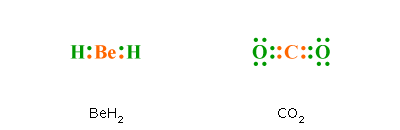
- the Lewis structure of the molecule or ion
In the following illustrations, all of the possible coordination geometries for different compounds are depicted using ball-and-stick models.
In each illustration, information such as number of electron pairs of the compound and the number of its atoms are given.
Linear Geometry
- number of electron pairs: 2
- coordination geometry: linear
- number of atoms: 3 ( 1 central atom, 2 bonding atoms)
Trigonal Planar Geometry
- number of electron pairs: 3
- coordination geometry: trigonal planar
- number of atoms: 4 ( 1 central atom, 3 bonding atoms)
Tetrahedral Geometry
- number of electron pairs: 4
- coordination geometry: tetrahedral
- number of atoms: 4-5 ( 1 central atom, 3-4 bonding atoms)
Trigonal Bipyramidal Geometry
- number of electron pairs: 5
- coordination geometry: trigonal bipyramidal
- number of atoms: 6 ( 1 central atom, 5 bonding atoms)
Octahedral Geometry
- number of electron pairs: 6
- coordination geometry: octahedral
- number of atoms: 7 ( 1 central atom, 6 bonding atoms)
Pentagonal Bipyramidal Geometry
- number of electron pairs: 7
- coordination geometry: pentagonal bipyramidal
- number of atoms: 8 ( 1 central atom, 7 bonding atoms)