Overhead Ad


Convert your measurements here:

March 12, 2013

Compounds With Planar Shape

Featured in this post are compounds having planar shape other than trigonal planar.

The following compounds are all planar, with the last two having more than one central atom.


xenon tetrafluoride, XeF4
benzene molecule, C6H6
CH2=NH


Geometry of Xenon Tetrafluoride, XeF4

The Lewis structure of xenon tetrafluoride, XeF4, below shows that the compound's central atom has four bonding electron pairs and two lone electron pairs.


According to the VSEPR theory, the arrangement that affords the maximum distance between each of the mentioned electron pairs is a square bipyramidal.


The axial positions of the two lone electron pairs offer the least net repulsion than it would have been if one or both of these non-bonding electron pairs were in the equatorial positions.


In the illustration shown above, a square bipyramidal outline is superimposed on the xenon tetrafluoride molecule.


  • shape of xenon tetrafluoride: square planar
  • F-Xe-F bond angle: 90°


Geometry of Benzene, C6H6

The resonance structures of benzene are shown below; the third structure is a suggested representation of the delocalization state of the pi electrons.


Each of the six carbon atoms can be taken as a central atom about which the geometry is trigonal planar.


The result is a hexagonal planar molecule with one carbon atom and one hydrogen atom jutting out at each of the six vertices.


Geometry of CH2=NH

The CH2=NH molecule has two central atoms, carbon and nitrogen (see the Lewis structure below).


About each center, the geometry is trigonal planar.


However, the shape about the nitrogen atom is angular due to the presence of a lone electron pair.


All of the atoms lie in one plane.

January 11, 2013

Compounds With Bent Shape

The following chemical species have bent geometry:

water molecule, H2O
nitrogen dioxide molecule, NO2
nitrite ion, NO2-
sulfur dioxide molecule, SO2

The illustrations and discussion below show how the presence of non-bonding electron pair(s) on a molecule's central atom affects the geometry of the molecule and the bond angle of its atoms.


Geometry of Water, H2O

As shown in its Lewis structure below, the central atom of water has four pairs of electrons: two bonding pairs and two non-bonding or lone pairs.


These pairs of electrons are presumed to take a tetrahedral arrangement in space.


Here, the water molecule is depicted as being superimposed in a tetrahedral outline.


The lone pairs of electrons are relatively closer to the nucleus of the central atom and they tend to crowd the two bonding pairs together so that the H-O-H bond angle is less than the ideal tetrahedral angle of 109.5°.


  • shape of water: bent or angular
  • H-O-H bond angle: 104.5°


Geometry of Nitrogen Dioxide, NO2

The central atom of nitrogen dioxide, nitrogen, has two sigma bond electron pairs and an unpaired non-bonding electron as shown in its Lewis electron dot structure below.


In order for this group of electrons to be farthest from each other, it is predicted that they take a trigonal planar arrangement.


Shown in the next illustration is the nitrogen dioxide molecule superimposed on a trigonal planar outline.


The observed O-N-O bond angle of 134.1° in nitrogen dioxide molecule, being closer to trigonal angle of 120°, confirms this prediction.

The opening out of the O-N-O bond angle is due to the less crowding affected by the half filled non-bonding orbital of the central atom.

This half-filled orbital accounts for the nitrogen dioxide (NO2) being paramagnetic.


  • shape of nitrogen dioxide: bent or angular
  • O-N-O bond angle: 134.1°


Geometry of Nitrite Ion, NO2-

An addition of an electron to the central atom of nitrogen dioxide (NO2) creates the nitrite anion, NO2-.


In the above diagram, the resonance structures of nitrite ion is shown. The oxygen atoms in red partial shades are atoms with negative formal charge.

As is the case with the nitrogen dioxide, the arrangement of the two sigma bond electron pairs and the lone electron pair of nitrite ion's central atom lies on a trigonal plane.


The only difference is the observed O-N-O bond angle of 115° for the nitrite ion. This bond angle now being much closer but less than the trigonal angle of 120° is attributed to the filling up of the non-bonding orbital of the nitrite ion's central atom.

The lone electron pair is relatively closer to the central atom and occupies more space than the adjacent bonding electron pairs do.


  • shape of nitrite ion: bent or angular
  • O-N-O bond angle: 115°


Geometry of Sulfur Dioxide, SO2

Referring to the contributing Lewis structures of sulfur dioxide below, there is a -1 formal charge on one of the oxygen atoms and +1 formal charge on the sulfur atom which cancel each other out, leaving the molecule with zero net charge.


Given the two sigma bond electron pairs and one lone electron pair on the central atom of sulfur dioxide, as shown in the figure above, SO2 is predicted to have a trigonal planar geometry.


A trigonal planar outline is shown below superimposed on the sulfur dioxide molecule.


Given this geometry, it is expected that SO2 molecule has an angular shape. This is supported by the fact that sulfur dioxide has a dipole moment.

The O-S-O bond angle is expected to be somewhat less than the trigonal angle of 120° due to the presence of a lone electron pair on the central atom.


  • shape of sulfur dioxide: bent or angular
  • O-S-O bond angle: less than 120°

September 3, 2012

Molecules With Linear Shape

Presented in this post are the illustrations of the geometry of the following linear molecules:
BeH2
CO2
HC≡CH
HC≡N
BeF2
BeCl2


Geometry of BeH2 ( beryllium dihydride )


  • shape of molecule: linear
  • bond angle: 180°


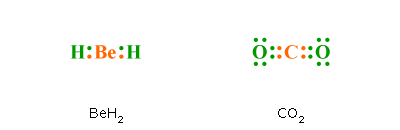
The Lewis structures of BeH2 and CO2


Geometry of CO2 ( carbon dioxide )


  • shape of molecule: linear
  • bond angle: 180°


Geometry of C2H2 ( ethyne or acetylene )


  • shape of molecule: linear
  • bond angle: 180°


The Lewis structures of C2H2 and HCN


Geometry of HC≡N ( hydrogen cyanide )


  • shape of molecule: linear
  • bond angle: 180°


Geometry of BeF2 ( beryllium difluoride )


  • shape of molecule: linear
  • bond angle: 180°


The Lewis structures of BeF2 and BeCl2


Geometry of BeCl2 ( beryllium dichloride )


  • shape of molecule: linear
  • bond angle: 180°

December 8, 2011

Compounds With Octahedral Shape

For compounds whose central atoms possess six bonding electron pairs, their bonded atoms are oriented towards the corners of an octahedron.

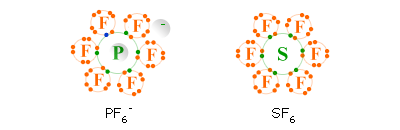
The best examples are the PF6- ( phosphorus hexafluoride or hexafluorophosphate) ion and the SF6 ( sulfur hexafluoride ) molecule whose Lewis structures are shown below.


The ground state electronic configuration of the two central atoms:
P1s2 2s2 2p6 3s2 3px1 3py1 3pz1
S1s2 2s2 2p6 3s2 3px2 3py1 3pz1


In the excited state of the two central atoms above, their valence electrons are assumed to be distributed this way:
1s2 2s2 2p6 3s1 3px1 3py1 3pz1 3dz21 3dx2 - y21


Since six equal orbitals are required, it is assumed that sp3d2 hybridization is used to form six hybrid orbitals:

1s2 2s2 2p6 (sp3d2)1 (sp3d2)1 (sp3d2)1 (sp3d2)1 (sp3d2)1 (sp3d2)1
Phosphorus acquires an extra electron for its sixth orbital.


Geometry of PF6-


  • shape of ion: octahedral
  • bond angle of axial atoms: 180°
  • bond angle of equatorial atoms: 90°
  • bond angle between an equatorial atom and an axial atom: 90°


Axial atoms are in white circles; equatorial atoms are in black circles.


An octahedron is superimposed on the PF6- ion.


Geometry of SF6


  • shape of molecule: octahedral
  • bond angle of axial atoms: 180°
  • bond angle of equatorial atoms: 90°
  • bond angle between an equatorial atom and an axial atom: 90°

November 28, 2011

Molecules With Trigonal Bipyramidal Shape

Molecules like PCl5 (phosphorus pentachloride) and PBr2Cl3 (phosphorus dibromo-trichloride) possess five covalent bonds whose electron pairs are arranged in a trigonal bipyramidal geometry.

The central atom of these molecules, phosphorus, has only three unpaired electrons out of its five valence electrons as can be seen from its electronic configuration below:

1s2 2s2 2p6 3s2 3px1 3py1 3pz1ground state configuration


But the Lewis structures of the given molecules, as shown below, indicate that the phosphorus atom uses five unshared electrons to form five covalent bonds.


It is, therefore, assumed that phosphorus uses the empty d orbital to "promote" 1 electron from 3s orbital to d orbital,

1s2 2s2 2p6 3s1 3px1 3py1 3pz1 3dz21excited configuration


and, through hybridization, form five sp3d hybrid orbitals which are then used to bond with chlorine and bromine atoms.

1s2 2s2 2p6 (sp3d)1 (sp3d)1 (sp3d)1 (sp3d)1 (sp3d)1excited configuration


Geometry of PCl5


  • shape of molecule: trigonal bipyramidal
  • bond angle of axial atoms: 180°
  • bond angle of equatorial atoms: 120°
  • bond angle between an equatorial atom and an axial atom: 90°


Axial atoms are in white circles; equatorial atoms are in black circles.


A trigonal bipyramid is superimposed on the PCl5 molecule.


Geometry of PBr2Cl3

Due to the different axial and equatorial positions the two bromine atoms can assume, PBr2Cl3 (phosphorus dibromo-trichloride) has three geometric isomers as shown below.


Except for the first isomer in which the bromine atoms are in axial positions, the other two geometric isomers of PBr2Cl3 are polar.

November 23, 2011

Molecular Geometry: Molecules With Trigonal Planar Shapes

Molecules with trigonal planar shape are characterized by their central atoms having 3 bonding electron pairs.

These electron pairs refer to those ones involved in sigma bonds only.

Electron pairs from pi bonds of double and triple bonds do not count.

In this particular coordination geometry, each electron pair is at an angle of 120° from any of the other two electron pairs.

The illustrations of the geometry and the Lewis structures given below are for the following molecules:
BF3
BCl3
SO3
H2C=O


Geometry of BF3

  • shape of molecule: trigonal planar
  • F-B-F bond angle: 120°

A trigonal plane is superimposed on the BF3 molecule.


Lewis structures of BF3 and BCl3


Due to its 3 valence electrons, boron does not follow the octet rule and thus forms electron-deficient compounds such as BF3 ( boron trifluoride ) and BCl3 ( boron trichloride ).

The characteristic reaction of the above compounds is to accept/share an electron pair from other atoms or compounds.

The reaction is called Lewis acid-base reaction.

A Lewis acid accepts a pair of electrons; a Lewis base donates a pair of electrons.


Geometry of BCl3


Geometry of SO3


Lewis structures of SO3 and H2C=O


Shown above is the Lewis structures of SO3 ( sulfur trioxide ) and H2C=O ( formaldehyde ) molecules.


Geometry of H2C=O