Overhead Ad


Convert your measurements here:

October 3, 2018

Percent Composition Calculator

In order to calculate the percent composition of a compound, you need to determine the weights of its constituent elements. For details and examples, see my previous post Percent Composition.

After determining the weight percentages of a compound's constituent elements, you can now calculate the individual weights of the elements contained in any given weight of that compound.

Percent Composition Calculator does just that. It provides you a quick check on your calculations whether you're solving or composing percent composition problems.

Just give the correct formula, weight and percent purity (if any) of the compound:

Formula. For the most commonly encountered binary inorganic compounds, a message is provided below the formula entry line if you enter their incorrect formula.

Weight. You can use any unit for the weight, meaning if your unit of weight is in grams then the computed weights of the compound's components will also be in grams.

% Purity. It is optional. If you don't enter a value, the application assumes that the compound is pure.

You need to round off the results to the required number of significant digits.


Percent Composition Calculator


(optional)


July 12, 2018

Percent Composition

Percent composition of a compound refers to the mass percentages (also expressed as % w\w) of the constituent elements of the compound. It indicates the individual weights of the elements in any given weight of the compound.

For a pure compound, percent composition gives its elemental analysis; for an impure compound, percent composition gives the percent purity of the compound.


Self-Assessment Test

You may take this test before and/or after reading this text.

Calculate the percent by weight of ?


Calculation

If the individual weights of the constituent elements of a compound are known, then calculation of percent composition is straightforward.

Just divide the weight of each of the constituent elements by the weight of the compound and then multiply by 100:

`((weight of e\l\ement)/(weight of compound))  x  100 = % weight`

Example 1  

A certain oxide of copper is found by experiment to contain 2.157 g of Cu and 0.543 g of O. Calculate its percent composition.

Step 1 To find the total weight of the compound, add the weights of the individual elements.

\begin{align}Cu\ \ \ 2.157\ g\\O\ \ \ 0.543\ g\\\_\_\_\_\_\_\_\_\_\\2.700\ g\end{align}

Step 2 In order to calculate the percent weights of the constituent elements, divide each weight of the elements by the weight of the compound and then multiply by 100.

`% Cu:`

`((2.157 g)/(2.700 g))  x  100 =  79.89%`


`% O:`

`((0.543 g)/(2.700 g))  x  100 =  20.11%`


Check that the total percentage is equal to 100.


If the weights are unknown, then percent composition can still be calculated from the known chemical formula of a compound.

It is made possible by considering the amounts of a compound and its components in terms of moles.

Example 2  

Let's calculate the percent composition of ammonium sulfate, (NH4)2SO4:

Step 1 Determine the number of moles of the constituent elements contained in 1 mole of the compound.

1 mole of (NH4)2SO4 contains:

  • 2 moles N
  • 8 moles H
  • 1 mole S
  • 4 moles O

Step 2 Convert these number of moles to weight in grams by multiplying them by the molar weights of the elements.

`weight of N:`

`2 mo\l\es  x  (14.0067 g)/(mo\l\e)  =  28.0134 g`


`weight of H:`

`8 mo\l\es  x  ( 1.0079 g)/(mo\l\e)  =    8.0632 g`


`weight of S:`

`1 mo\l\e  x  (32.0666 g)/(mo\l\e)  =  32.0666 g`


`weight of O:`

`4 mo\l\es  x  (15.9994 g)/(mo\l\e)  =  63.9976 g`

Step 3 Add all the weights of the elements. This total is the weight of 1 mole of the compound. It is also known as the formula weight of the compound.

\begin{align}28.0134\ g\\8.0632\ g\\32.0666\ g\\63.9976\ g\\\_\_\_\_\_\_\_\_\_\\132.1408\ g\end{align}

Step 4 Divide each weight of the elements by the formula weight of the compound.

`% N:`

`((28.0134 g)/(132.1408 g))  x  100 =  21.20%`


`% H:`

`((8.0632 g)/(132.1408 g))  x  100 =    6.10%`


`% S:`

`((32.0666 g)/(132.1408 g))  x  100 =  24.27%`


`% O:`

`((63.9976 g)/(132.1408 g))  x  100 =  48.43%`


Their total percentage must be equal to 100.


Uses

Percent composition is used to calculate the weight of a particular element in any given weight of a compound.

Example 3  

Let's calculate the individual weights of the constituent elements present in 5.0 g of (NH4)2SO4.

Step 1 Find the percent composition of the compound.

As calculated in Example 2 , the percent composition of (NH4)2SO4 is:

\begin{align}N\ \ \ \ 21.20\ \%\\H\ \ \ \ \ \ 6.10\ \%\\S\ \ \ \ \ 24.27\ \%\\O\ \ \ \ \ 48.43\ \%\end{align}

Step 2 To determine the individual weights of the elements, multiply the mass percentage of each element by the given weight of the compound.

`weight of N:`

`5.0 g   x   0.2120 =  1.1  g`


`weight of H:`

`5.0 g   x   0.0610 =  0.3  g`


`weight of S:`

`5.0 g   x   0.2427 =  1.2  g`


`weight of O:`

`5.0 g   x   0.4843 =  2.4  g`


Step 3 Check that the total of the weights of the individual elements is equal to the given weight of the compound.

\begin{align}N\ \ \ \ 1.1\ \ g\\H\ \ \ \ 0.3\ \ g\\S\ \ \ \ \ 1.2\ \ g\\O\ \ \ \ \ 2.4\ \ g\\\_\_\_\_\_\_\_\_\_\\5.0\ \ g\end{align}


Percent composition is also used in the determination of the empirical formula of a compound. This is another topic that will be covered in a subsequent post.


November 17, 2017

Formula Weight Calculation

This text teaches you how to calculate the formula weight of a substance.

Before you begin, please take note that you should have a basic understanding of the following concepts:

  • ions and molecules
  • mole
  • hydrated compounds


Self-Assessment Test

You may take this test before and/or after reading this text.

Click START button to begin the test comprising of four questions.


Definition of Formula Weight

Formula weight is the sum of the atomic weights of all the atoms indicated in the chemical formula of a substance. It is the weight in grams of 1 mole of that substance, usually expressed as grams per mole. Hence, it is also sometimes called the molar weight.

The quantity of the atoms in a given formula is indicated by a numerical subscript after each atom. If no subscript is present after an atom, it is assumed to have a numerical subscript of one.


Formula Weight or Molecular Weight?

Formula weight is a generic term that may be used for both substances that exist as ions and molecules. Whereas, molecular weight is applicable only to substances that exist as molecules.


Uses of Formula Weight

Formula weight is used in the following:

  • stoichiometry problems
  • mole calculation
  • percent composition calculation
  • empirical formula calculation

Note: The following calculations are based on atomic weights with three significant digits.

Example Calculation 1

Formula weight of water, H2O :

H

O

2

1

x

x

1.008

15.999

=

=

2.016

15.999

18.015


Example Calculation 2

Formula weight of ammonium carbonate, (NH4)2CO3 :

N

H

C

O

2 x 1

2 x 4

1

3

x

x

x

x

14.007

1.008

12.011

15.999

=

=

=

=

28.014

8.064

12.011

47.997

96.086


Example Calculation 3

Formula weight of calcium chloride hexahydrate, CaCl2.6H2O :

Ca

Cl

H

O

1

2

6 x 2

6 x 1

x

x

x

x

40.078

35.453

1.008

15.999

=

=

=

=

40.078

70.906

12.096

95.994

219.074

March 12, 2013

Compounds With Planar Shape

Featured in this post are compounds having planar shape other than trigonal planar.

The following compounds are all planar, with the last two having more than one central atom.


xenon tetrafluoride, XeF4
benzene molecule, C6H6
CH2=NH


Geometry of Xenon Tetrafluoride, XeF4

The Lewis structure of xenon tetrafluoride, XeF4, below shows that the compound's central atom has four bonding electron pairs and two lone electron pairs.


According to the VSEPR theory, the arrangement that affords the maximum distance between each of the mentioned electron pairs is a square bipyramidal.


The axial positions of the two lone electron pairs offer the least net repulsion than it would have been if one or both of these non-bonding electron pairs were in the equatorial positions.


In the illustration shown above, a square bipyramidal outline is superimposed on the xenon tetrafluoride molecule.


  • shape of xenon tetrafluoride: square planar
  • F-Xe-F bond angle: 90°


Geometry of Benzene, C6H6

The resonance structures of benzene are shown below; the third structure is a suggested representation of the delocalization state of the pi electrons.


Each of the six carbon atoms can be taken as a central atom about which the geometry is trigonal planar.


The result is a hexagonal planar molecule with one carbon atom and one hydrogen atom jutting out at each of the six vertices.


Geometry of CH2=NH

The CH2=NH molecule has two central atoms, carbon and nitrogen (see the Lewis structure below).


About each center, the geometry is trigonal planar.


However, the shape about the nitrogen atom is angular due to the presence of a lone electron pair.


All of the atoms lie in one plane.

January 11, 2013

Compounds With Bent Shape

The following chemical species have bent geometry:

water molecule, H2O
nitrogen dioxide molecule, NO2
nitrite ion, NO2-
sulfur dioxide molecule, SO2

The illustrations and discussion below show how the presence of non-bonding electron pair(s) on a molecule's central atom affects the geometry of the molecule and the bond angle of its atoms.


Geometry of Water, H2O

As shown in its Lewis structure below, the central atom of water has four pairs of electrons: two bonding pairs and two non-bonding or lone pairs.


These pairs of electrons are presumed to take a tetrahedral arrangement in space.


Here, the water molecule is depicted as being superimposed in a tetrahedral outline.


The lone pairs of electrons are relatively closer to the nucleus of the central atom and they tend to crowd the two bonding pairs together so that the H-O-H bond angle is less than the ideal tetrahedral angle of 109.5°.


  • shape of water: bent or angular
  • H-O-H bond angle: 104.5°


Geometry of Nitrogen Dioxide, NO2

The central atom of nitrogen dioxide, nitrogen, has two sigma bond electron pairs and an unpaired non-bonding electron as shown in its Lewis electron dot structure below.


In order for this group of electrons to be farthest from each other, it is predicted that they take a trigonal planar arrangement.


Shown in the next illustration is the nitrogen dioxide molecule superimposed on a trigonal planar outline.


The observed O-N-O bond angle of 134.1° in nitrogen dioxide molecule, being closer to trigonal angle of 120°, confirms this prediction.

The opening out of the O-N-O bond angle is due to the less crowding affected by the half filled non-bonding orbital of the central atom.

This half-filled orbital accounts for the nitrogen dioxide (NO2) being paramagnetic.


  • shape of nitrogen dioxide: bent or angular
  • O-N-O bond angle: 134.1°


Geometry of Nitrite Ion, NO2-

An addition of an electron to the central atom of nitrogen dioxide (NO2) creates the nitrite anion, NO2-.


In the above diagram, the resonance structures of nitrite ion is shown. The oxygen atoms in red partial shades are atoms with negative formal charge.

As is the case with the nitrogen dioxide, the arrangement of the two sigma bond electron pairs and the lone electron pair of nitrite ion's central atom lies on a trigonal plane.


The only difference is the observed O-N-O bond angle of 115° for the nitrite ion. This bond angle now being much closer but less than the trigonal angle of 120° is attributed to the filling up of the non-bonding orbital of the nitrite ion's central atom.

The lone electron pair is relatively closer to the central atom and occupies more space than the adjacent bonding electron pairs do.


  • shape of nitrite ion: bent or angular
  • O-N-O bond angle: 115°


Geometry of Sulfur Dioxide, SO2

Referring to the contributing Lewis structures of sulfur dioxide below, there is a -1 formal charge on one of the oxygen atoms and +1 formal charge on the sulfur atom which cancel each other out, leaving the molecule with zero net charge.


Given the two sigma bond electron pairs and one lone electron pair on the central atom of sulfur dioxide, as shown in the figure above, SO2 is predicted to have a trigonal planar geometry.


A trigonal planar outline is shown below superimposed on the sulfur dioxide molecule.


Given this geometry, it is expected that SO2 molecule has an angular shape. This is supported by the fact that sulfur dioxide has a dipole moment.

The O-S-O bond angle is expected to be somewhat less than the trigonal angle of 120° due to the presence of a lone electron pair on the central atom.


  • shape of sulfur dioxide: bent or angular
  • O-S-O bond angle: less than 120°

September 3, 2012

Molecules With Linear Shape

Presented in this post are the illustrations of the geometry of the following linear molecules:
BeH2
CO2
HC≡CH
HC≡N
BeF2
BeCl2


Geometry of BeH2 ( beryllium dihydride )


  • shape of molecule: linear
  • bond angle: 180°


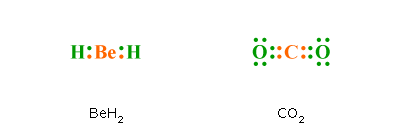
The Lewis structures of BeH2 and CO2


Geometry of CO2 ( carbon dioxide )


  • shape of molecule: linear
  • bond angle: 180°


Geometry of C2H2 ( ethyne or acetylene )


  • shape of molecule: linear
  • bond angle: 180°


The Lewis structures of C2H2 and HCN


Geometry of HC≡N ( hydrogen cyanide )


  • shape of molecule: linear
  • bond angle: 180°


Geometry of BeF2 ( beryllium difluoride )


  • shape of molecule: linear
  • bond angle: 180°


The Lewis structures of BeF2 and BeCl2


Geometry of BeCl2 ( beryllium dichloride )


  • shape of molecule: linear
  • bond angle: 180°

December 8, 2011

Compounds With Octahedral Shape

For compounds whose central atoms possess six bonding electron pairs, their bonded atoms are oriented towards the corners of an octahedron.

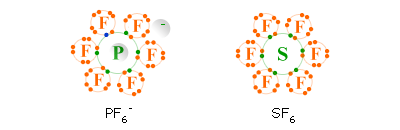
The best examples are the PF6- ( phosphorus hexafluoride or hexafluorophosphate) ion and the SF6 ( sulfur hexafluoride ) molecule whose Lewis structures are shown below.


The ground state electronic configuration of the two central atoms:
P1s2 2s2 2p6 3s2 3px1 3py1 3pz1
S1s2 2s2 2p6 3s2 3px2 3py1 3pz1


In the excited state of the two central atoms above, their valence electrons are assumed to be distributed this way:
1s2 2s2 2p6 3s1 3px1 3py1 3pz1 3dz21 3dx2 - y21


Since six equal orbitals are required, it is assumed that sp3d2 hybridization is used to form six hybrid orbitals:

1s2 2s2 2p6 (sp3d2)1 (sp3d2)1 (sp3d2)1 (sp3d2)1 (sp3d2)1 (sp3d2)1
Phosphorus acquires an extra electron for its sixth orbital.


Geometry of PF6-


  • shape of ion: octahedral
  • bond angle of axial atoms: 180°
  • bond angle of equatorial atoms: 90°
  • bond angle between an equatorial atom and an axial atom: 90°


Axial atoms are in white circles; equatorial atoms are in black circles.


An octahedron is superimposed on the PF6- ion.


Geometry of SF6


  • shape of molecule: octahedral
  • bond angle of axial atoms: 180°
  • bond angle of equatorial atoms: 90°
  • bond angle between an equatorial atom and an axial atom: 90°